From the hour logged to the invoice, without losing the trail.
Every hour carries the proposal, the cost and the price from the moment it is logged. Nimbos shows who has not logged yet, works out overtime and the hour bank by your collective agreement, and builds the margin, the client's breakdown and the amount to invoice — all from that same hour.
From R$9.00 per person/month · No card needed to talk · Data hosted in Brazil
| Proposal | Hours | Cost | Revenue | Margin |
|---|---|---|---|---|
| Client portal — phase 2Squad of 4 · priced by role | 412:30 | R$38,140 | R$61,875 | 38.4% |
| Monthly supportFixed price · hours logged | 286:00 | R$27,170 | R$34,320 | 20.8% |
| Data migrationTight deadline · fixed scope | 164:1522:30 OT | R$17,220 | R$19,710 | 12.6% |
| Dedicated squad — quarterPriced by role · overtime billed | 508:459:00 OT | R$45,790 | R$76,312 | 40.0% |
| Partial total | 1,371:30 | R$128,320 | R$192,217 | 33.2% |
The thinnest line is there on purpose. A close exists to find the contract that is tightening while there is still time to talk to the client — not to collect good news on the 5th of the following month.
The hour goes in once and crosses the whole month
No step asks for the number again. Each one reads what the previous one saved.
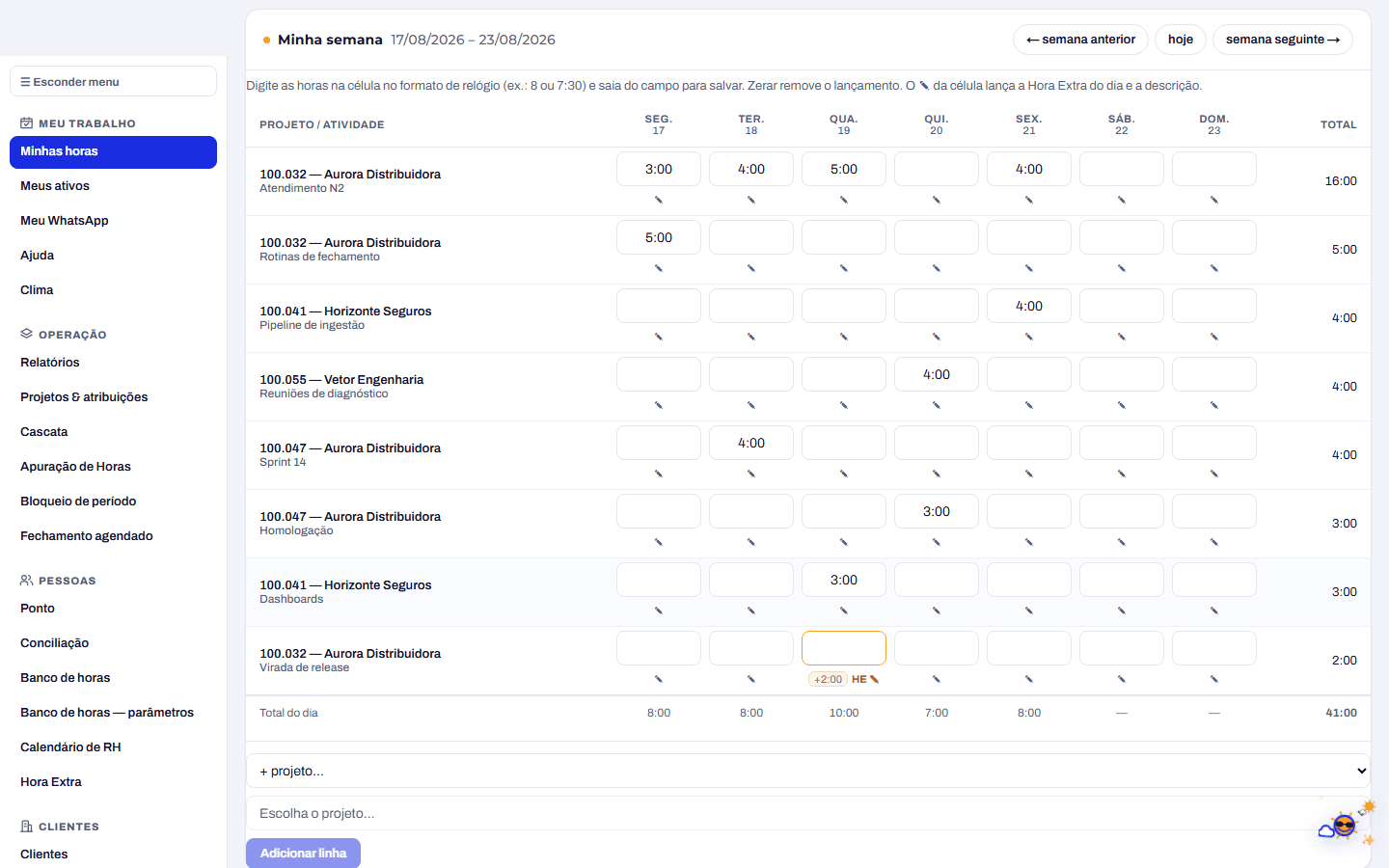
One line on the week grid: the proposal and whatever detail your company wants. A new company starts with two levels — Project and Activity — and up to five fit, counting the proposal. Whoever forgets shows up on D+1, not at closing.
The person's cost per hour and the role's price on that proposal produce the margin live. It is not a report someone assembles: it follows from what was already logged. Only who you allow can see cost.
On invoicing, that moment's price and cost are written onto the hour itself, with date and author. Renegotiating in September does not move August's invoice. Reopening the month is possible, audited, and belongs to whoever holds that permission.
From what was closed, Nimbos works out how much goes on the month's invoice and how each proposal breaks down. In Barueri-SP it also assembles the remittance file in the city's layout — sending it to the city remains a separate step.
- Hours
- They come from the week grid. One line per proposal, filled in once.
- Cost
- Each person's cost per hour. Visible only to whoever holds that permission.
- Revenue
- A price table by role, set proposal by proposal and cloneable between them.
- Margin
- The subtraction of the two above. Nobody types this column.
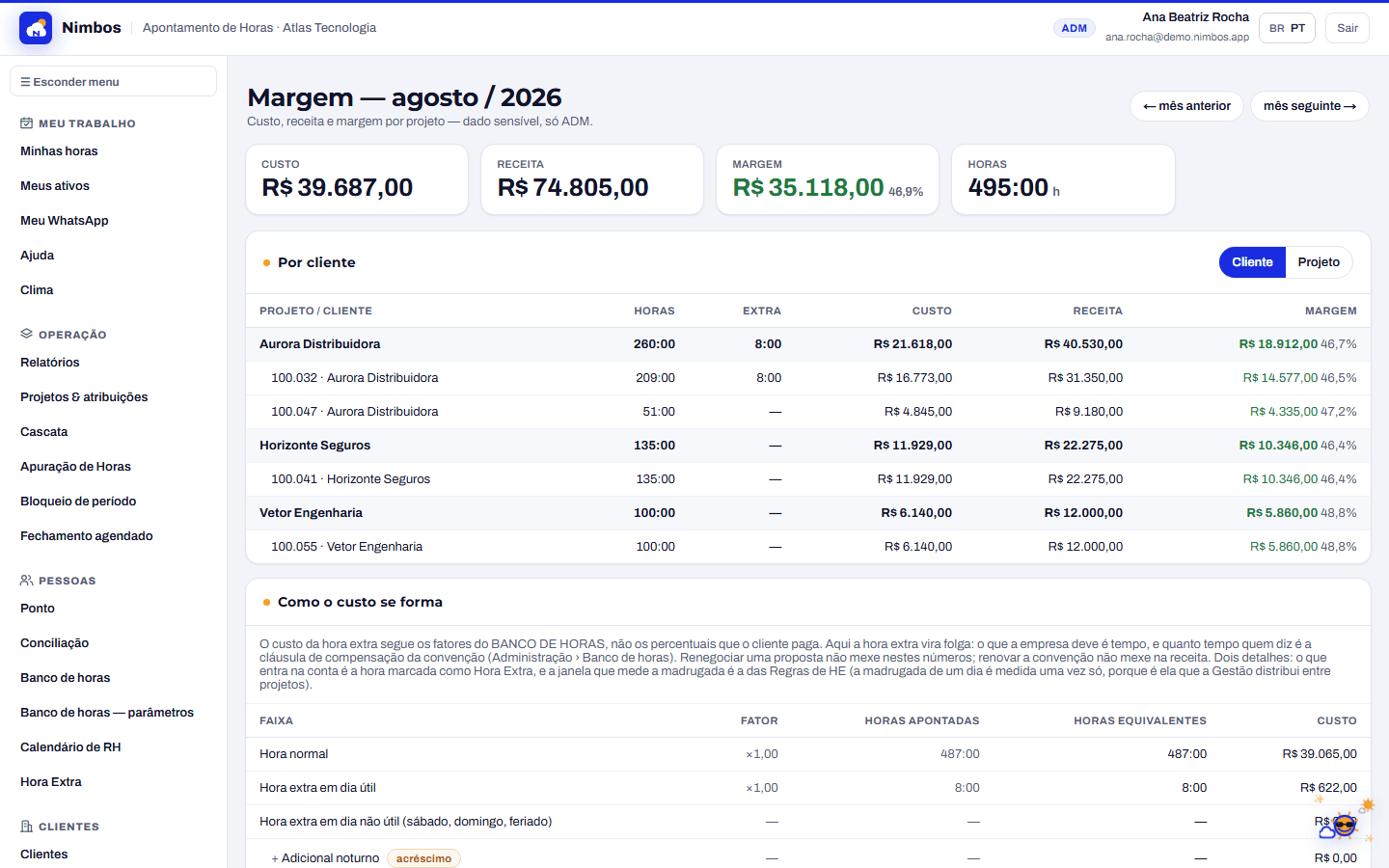
The statement above is a real screen
The same sum, inside Nimbos: cost, revenue and margin by client and by proposal, with the overtime column and the month's totals.
- Cost per person and price by role, proposal by proposal
- Who sees cost is who you allow — the margin has an owner
- Once invoiced, the number does not move unless someone reopens the month
Two overtimes with the same name
One the client pays. The other the team takes as time off. In the same spreadsheet they become one thing — and you end up billing hours that already became time off, or granting time off for hours nobody billed.
At closing, each person comes out with their overtime, the night hours, what gets billed and what it costs — the figures ready for whoever runs payroll.
Follows the contract, not the labor agreement
Each contract sets whether it bills overtime, and at what premium. Two contracts from the same client can bill differently — and often do.
Who changes this rule is your sales side.
Follows the collective labor agreement
The cycle, weekday and Sunday factors, night premium and caps are your company's — nothing is hard-set. The balance becomes time off.
Who changes this rule is the union.
Nimbos does not tie the two together, on purpose. Renegotiating a contract touches nobody's balance; renewing the labor agreement doesn't change what the client pays.
The questions we always get
- We already use Clockify.
- It connects through the API and brings the history over, one month at a time. Syncing the same period again does not create copies. What Clockify does not do: hour bank, time-clock mirror, overtime by your collective agreement, and margin by proposal.
- My team will not fill it in.
- One line per proposal on the week grid. The delay shows up on D+1, in five weather states — not on closing day, when chasing it no longer helps. No stopwatch, no screenshots, no location tracking.
- What about the data?
- Hosted in Brazil. Each company isolated from the others in the database, and each person seeing only what belongs to them. Support access, when it exists, is granted by you — and it expires.
One line, and the rest is a conversation
R$9.00 per person/month
Minimum invoice of R$90.00. With no commitment, R$20.00 per person/month, cancellable at any time.
Time entry, contracts, people and roles always come in. Time clock, hour bank, overtime, billing, invoicing, reports, approval and assets are modules — your company turns on the ones it will use. See pricing
Start with the month you're closing right now
A fifteen-minute conversation settles whether Nimbos fits your case. If it doesn't, I'll say so.
Sales channel. If your company already uses Nimbos, support goes through your administrator.
Coming from Clockify? Your history comes along through the API — and syncing again creates no copies.